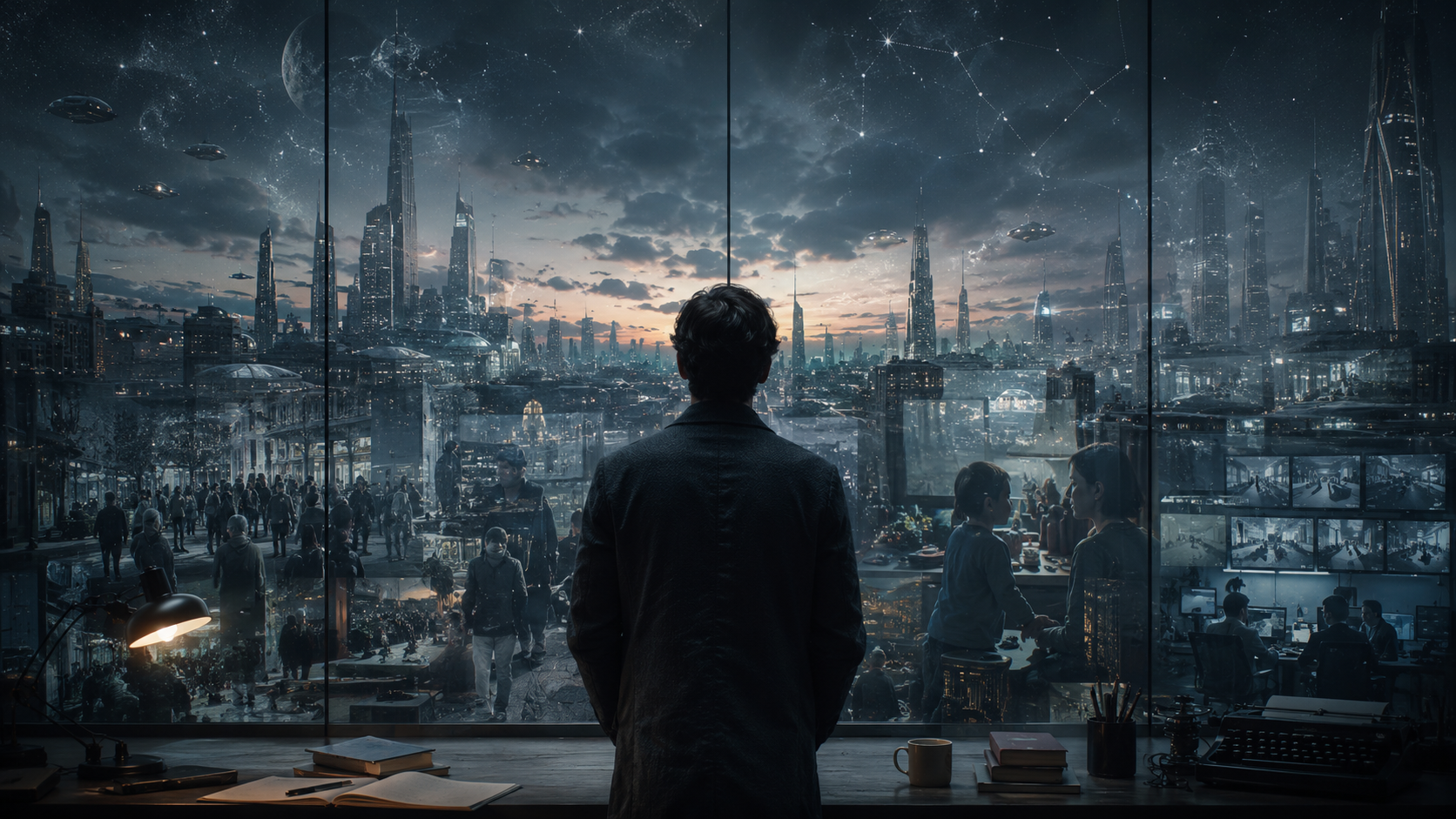
Science fiction is often treated like an escape hatch. We think of starships, distant planets, artificial intelligence, alien civilizations, and futures so far removed from our daily lives that they seem to belong somewhere else entirely. Yet the best science fiction has never really been about somewhere else. It has always been about us.
That is what makes this genre so powerful. Science fiction gives writers and readers enough distance to look honestly at the present. A story set on another planet can reveal how power works here on Earth. A dystopian government can expose how ordinary people become comfortable inside systems that limit them. A machine intelligence can force us to ask what we value about human choice, memory, creativity, and responsibility. The future in science fiction is rarely just a prediction. It is a TEST. When a story imagines new technology, new governments, or new social orders, it is asking what people will do when familiar rules are stretched to their breaking point. Who adapts? Who resists? Who benefits? Who gets left behind?
That is why science fiction keeps returning to questions of identity, control, ambition, survival, and belonging. The settings may change, but the emotional core stays recognizable. We see characters trying to make meaning in systems larger than themselves. We see people caught between progress and consequence. We see societies that tell themselves they are building a better future while quietly repeating the same old mistakes. That have been repeated throughout history.
In a sense, science fiction is not a retreat from our everyday realities. It is a more entertaining way to study it. By changing the surface of the world, the genre provides us the ability to see the hidden patterns. It turns technology into a moral question. It turns an empire into a character test. It turns the future into a mirror. That mirror can be uncomfortable. Good science fiction does not simply ask what inventions might exist tomorrow. It asks what kind of people we are becoming today. It asks how much freedom we are willing to trade for comfort, how much truth we are willing to ignore for stability, and how easily a society can confuse progress with wisdom.
This is why I am drawn to science fiction as both a reader and a writer. The genre makes room for imagination, but it also demands attention. It invites wonder while still asking difficult questions. It lets us build strange worlds, then uses those worlds to reveal familiar human patterns.
Science fiction is really about us because every imagined future begins with present fears, hopes, conflicts, and choices. The spaceships and machines matter, but they are not the heart of the story. The heart is what people do with power, what they remember, what they sacrifice, and what they decide to become.
The future is never only the future. In science fiction, it is a way of seeing the present more clearly.