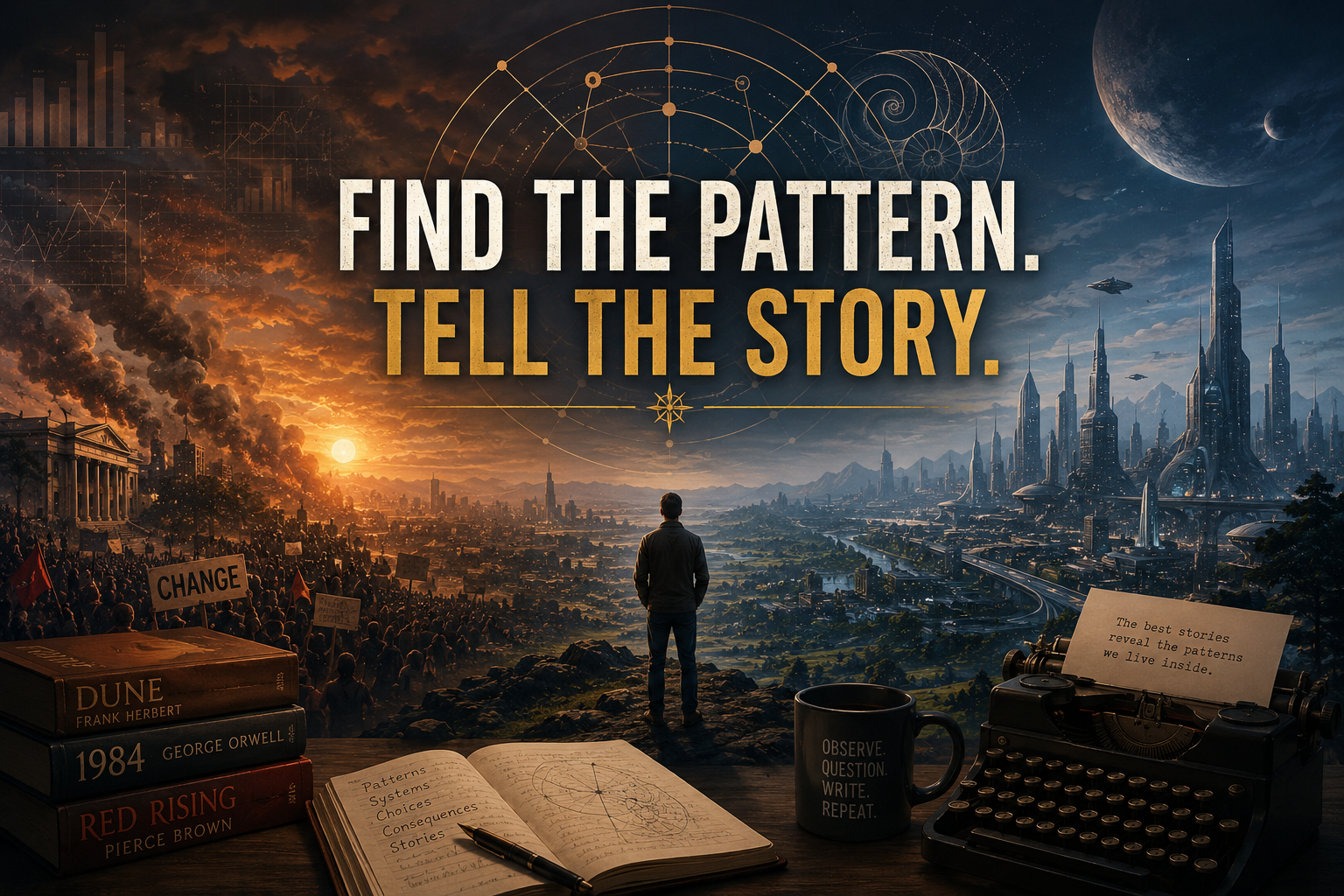
Every story begins with a question. Not simply what happens next, but why does it happen at all?
The phrase “ Find the Pattern. Tell the Story”, which sits at the center of my website is the central focus of all my writing. The older I get, the more I notice that life is built from patterns.
Patterns shape families, businesses, communities and nations. These patterns influence the rise and fall of civilizations. They determine how power is gained, how trust is lost, and how people respond when they are afraid, hopeful, desperate, or perhaps inspired.
For most people, these patterns are invisible while we are living inside them. We see events, holidays, elections, promotions, arguments, and celebrations. That lead to outcomes, the who won, who lost, who succeeded, and who failed. We see headlines every day, a flood of opinions, reactions, and interpretations. What we often miss are the underlying forces connecting those moments together.
That is the valuable insight that stories bring to those who read and look for more beyond the entertainment value that is often what most reader look for in their fiction.
To me a great story does more than entertain. It helps us recognize patterns we might otherwise overlook. It allows us to step back from our own lives and observe human behavior from a different perspective. A fictional world offers perhaps the safest way to examine an uncomfortable truth.
For me, writing has become a way of exploring those deeper structures. Not just through my daily journaling practice, but through the stories I create. I am deeply fascinated by systems.
Every organization operates according to a set of rules, whether written or unwritten. Families develop traditions and expectations. Governments create institutions. Cultures pass beliefs from one generation to the next. Over time, these systems begin shaping the choices available to the people living within them.
Many of the stories I write start with a simple question:
What happens when a system is pushed to its logical extreme? What happens when efficiency becomes more important than freedom? What happens when information becomes more valuable than truth? What happens when technology evolves faster than human wisdom? What happens when people forget why a system was created in the first place?
These questions are not really about the future. They are about us and the choices we make today and the systems we just might create tomorrow. That is one reason I am drawn to science fiction.
Science fiction has always been a powerful tool for making hidden patterns visible. By moving a story into the future, onto another planet, or into an unfamiliar society, writers can examine ideas that already exist in the present.
Frank Herbert used Dune to explore power, religion, and leadership. George Orwell used 1984 to examine surveillance and control. Pierce Brown used Red Rising to examine how power structures sustain themselves across generations and what it takes to challenge them.
The settings were fictional, and yet their patterns were real. The best science fiction acts as both a window and a mirror. Offering it readers the opportunity to imagine what could happen while helping us understand what is happening right now.
That philosophy connects directly to the projects featured on this website.
In The Silence Protocol, I explore the beginnings of a society that places efficiency above all else and the human cost of maintaining perfect order.
In The Legacy of Sol, I expand that idea of efficiency across generations, examining how civilizations evolve, fracture, and rebuild, and how stories themselves become part of the systems that shape humanity’s future.
Even the nonfiction writing on this site will follow the same path. Whether I am discussing leadership, personal growth, journaling, technology, or storytelling, I am very likely asking the same question:
What pattern am I seeing here, and what story does it reveal?
The goal is not to provide easy answers. The goal I strive for is to ask better questions. Once we recognize a pattern, we gain the ability to examine it. It is that exaimation, that provides us the ability to change it. That is why I write.
To find the pattern. And then tell the story.